Mostrando entradas con la etiqueta phonics. Mostrar todas las entradas

mi茅rcoles, 2 de enero de 2019

REVIEW

Finish learning phonics? Never!! You have plenty of resources to keep practicing them and learning more.
Something we can do as teachers is help our students by creating review lessons for the different groups. Here I show you one example of a review lesson.


The first content I included in my review lesson is about tricky words. This words are very difficult for the children because they don't follow any rule. In this exercise the children will have to see and then try to write correctly the words without looking. Finally they have to complete the words with the correct missing letter.


In the next activity they have to join the small letters with their corresponding capital letters. 


Now it's rhyme time!! Here they have to join the words with the pictures with which they rhyme. I believe thay rhyming is a nice activity for children, because it's attractive and it makes it easy for them to remember content.


The next two slides are about content. Children have to learn that when there are two letters together making the same sound, there is only one sound. Then you can provide them with examples to show them this rule.


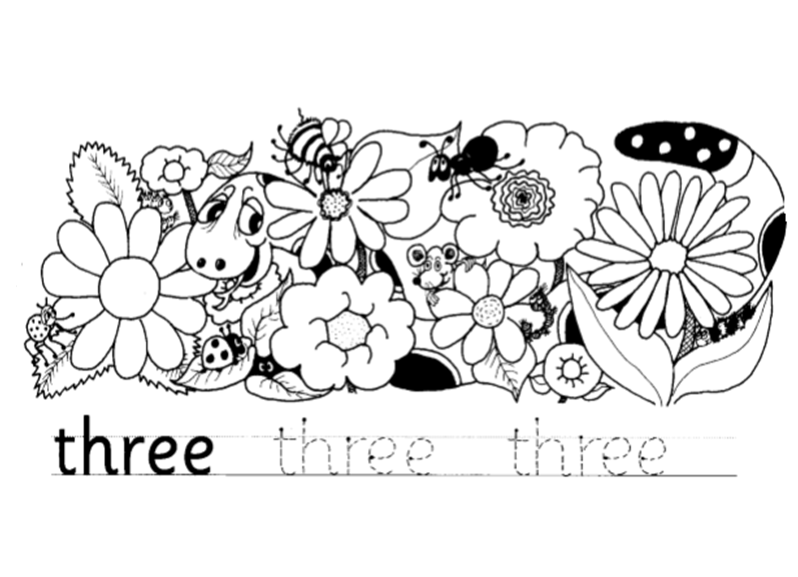
 Finally, I've decided to include the writing of numbers. It's important that the children know how to draw and write the numbers. 


I hope you have enjoyed the example review and it will be useful for your English lessons. 馃槈


GROUP 7: qu, ou, oi, ue, er, ar

Final group, group 7!! This is the last group and maybe the most difficult one for the children. It has many different types of syllables: blends, vowel teams and r controlled.

For this teaching sequence I've chosen the r controlled sound "ER". As all the others, the teaching sequence has the three parts: listen and do, phonemic awareness and phonics and listen and make, finishing with the letter fans. This time, the letter fans will be really important, because they will help a lot the children to understand this wide range of diversity of sounds and syllables. 


With this group seven we have already completed all the groups. I hope this teaching sequences help you and give you some ideas for your English clases. 
As I've said a couple times, on the right column you have a list with some interesting websites to find more resources ⇒

GROUP 6: y, x, ch, sh, th

Difficult one, group six!! My example of teaching sequence is with the sound "X".
There will be no differences with the other ones and we will keep working with the letter fans as the children enjoy them a lot.


GROUP 5: z, w, ng, v, oo

Grouppppp fiveeeee!! Wow, we are reaching the end!
This time the sound will be... "OO". The teaching sequence will be the same as always with the three differentiated parts and we will use, as in group 4, the letter fans for the children to consolidate more easily the pronounciation of the different sounds and the division of the syllables and sounds of the words.


GROUP 4: ai, j, oa, ie, ee, or

We are hereeeee, group 4!! We have already completed more than half of all the groups! This time I've chosen the vowel team "IE" to create my teaching sequence. 

This vowel team concept is someting new for the students, so the teaching sequence has some new activities. 
The start is the same: listen and do for introduction.


Then we have phonemic awareness and phonics, but this time, between this two, I've added the song "When two vowels go walking" . This funny song will help the children understand how they have to pronounce a vowel team.


Finally, in the listen and make part, you can supply the children a worksheet with different sounds. They have to cut out the sounds and then, making a fan they will have to form words.


The source of this letter fans worksheet is "Sparkle box" which is a fantastic website where you can find a wide range of resources for your English classes. (You already have it on the list 馃槈)

GROUP 3: g, o, u, l, f, b

Group 3!! Step by step we're are completing the groups. In this case, I've chosen letter "F" in order to show you a teaching sequence as an example. The structure is the same as always: listen and do, phonemic awareness and phonics, and, finally, listen and make.


This time, I've decided to add a final game for the students. The game is about answering some simple yes/no questions in order to introduce to the students the structure of this questions.


I found this game searching in the website http://www.letters-and-sounds.com. I've provided you with a list of interesting websites where you can find this one and many others, you have this list in the column of your right. 馃槈


GROUP 2: ck, e, h, r, m, d

We have already reached group two. In this case I've chosen letter "R" to give you an example of a teaching sequence you can follow in one of your lessons. 
I've followed the same structure as in the previous group: 
1. Listen and do: introduction, action and song
2. Phonemic awareness and phonics: identifying syllables and segmenting and blending
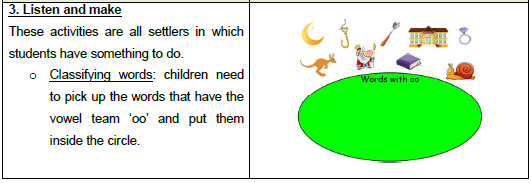
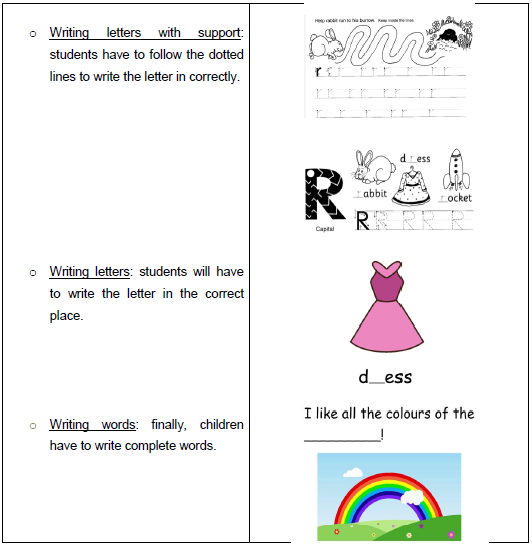
3. Listen and make with TPR approach: identifying the sound and writing letters and words.


GROUP 1: s, a, t, i, p, n

Starting with the phonics, here you have an example of a teaching sequence to teach sound "P". 

I've used first some listen and do introduction activities. The first will be an introduction to the letter and the action for it. Then I will use a song, where they have to do the action  when the sound appears and at the same time they sing.

The second part will be about phonemic awareness and phonics. In phonemic awareness they will have to be able to identify the number of syllables each word that appears in the board has. The part of phonics will be segmenting and blending the sounds in the previous words .


Finally, I will use TPR (Total Physical Response) activities of listen and make, so they will be physically involved.
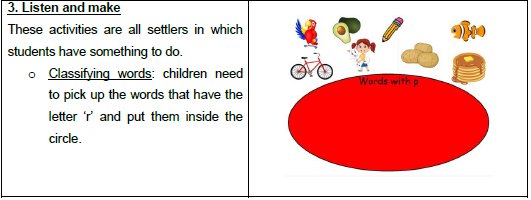
In the first one they will have to identify the words that have the sound "P" and put them inside the oval. 
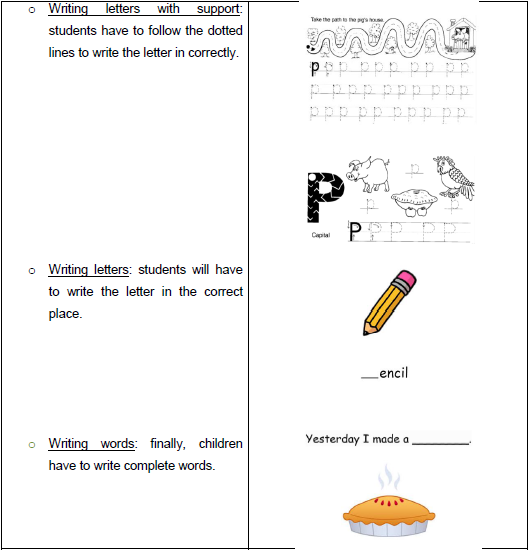
Then, I will introduce them in writing: first writing the letter with support, then writing the letter in the correct place without support and finally writing complete words inside different sentences.